
Top Garden Screening Ideas for Privacy & Style
Privacy of the outdoor space can significantly change how a home is used. Without it, courtyards, alfresco areas and pools tend to sit unused; with the right screening in place, they become an extension of daily living. Good outdoor privacy solutions balance two things that are easy to get wrong on their own: genuine privacy from neighbours and the street, and a look that still feels considered rather than defensive.
At DW Architects, we treat boundary screening as part of the architecture of a home, not something stuck on once the landscaping is finished. The options below are the most popular across Australian projects, from full aluminium fencing to softer, plant-based solutions.
read more: Architect in Melbourne
Choosing the Best Outdoor Fence Style for Privacy & Aesthetics
The right fence style depends on what you’re actually screening from. A boundary next to a busy footpath needs a different response to a side fence between two homes, or a pool area that also has to meet safety requirements.
Solid fencing gives full privacy but can feel heavy on a smaller block.
Slatted or louvred styles soften that effect, letting light and airflow through while still blocking sightlines at eye level. Mixed-height designs, part solid, part open above, are a useful middle ground where full privacy isn’t needed along the entire boundary.The best outdoor privacy solutions are chosen block by block rather than applied as a single default across the whole property.
read more: Interior Designers Melbourne
Comparing Modern Privacy Fence Materials: Aluminium, Timber & Beyond
Material choice affects appearance, maintenance and how the fence performs over time, particularly in Australian conditions where UV exposure, humidity and coastal salt air all take a toll. Aluminium offers a clean, low-maintenance finish and holds its colour well even in harsh sun. Timber brings warmth and texture but needs more upkeep depending on species and exposure.
Composite and hybrid products sit between the two, aiming for a timber look with lower maintenance demands. Steel and masonry options suit a more permanent, architectural boundary but come with a higher upfront cost.There’s no single correct material; the right one depends on budget, site’s exposure, maintenance the client is willing to take on, and how the fence needs to sit against the rest of the home’s material palette.
read more: Essential Modern Building Principles
Why Aluminium Fencing Is a Top Choice for Long-Term Durability
Of the common options, aluminium tends to perform particularly well over the long term. It doesn’t rust, doesn’t warp, and holds up well in coastal areas where salt air corrodes steel fittings and greys out timber faster than inland sites.
Powder-coated finishes now come in a wide colour range, so aluminium no longer reads as purely utilitarian; slatted aluminium in a matte charcoal or timber-look finish can sit comfortably alongside a more architectural home. Combined with minimal maintenance, this is why we specify aluminium as a default recommendation on projects where the fence needs to look as good in ten years as it does on installation day.
read more: Architect in Lorne
Breeze Blocks as a Stylish Retro-Inspired Privacy Solution
Breeze blocks have moved from a mid-century staple back into current use, and for good reason. The perforated pattern filters light and airflow through a wall while still breaking sightlines, which makes it a strong option for a pool boundary or a courtyard wall that would otherwise feel enclosed.
They read as architectural rather than purely functional, and they pair well with both a retro material palette and a more contemporary rendered finish. Because the wall is solid, breeze block also carries acoustic and wind-screening benefits that lighter screening options don’t offer to the same degree.
read more: Residential Architects in Melbourne
Custom Timber Screening Ideas for Natural Outdoor Privacy
Timber screening remains the material most people associate with warmth in an outdoor space, and it earns that reputation when it’s detailed well. Vertical battens, horizontal slats, and woven or basket-weave patterns each throw a different shadow line and offer a different degree of visual permeability.
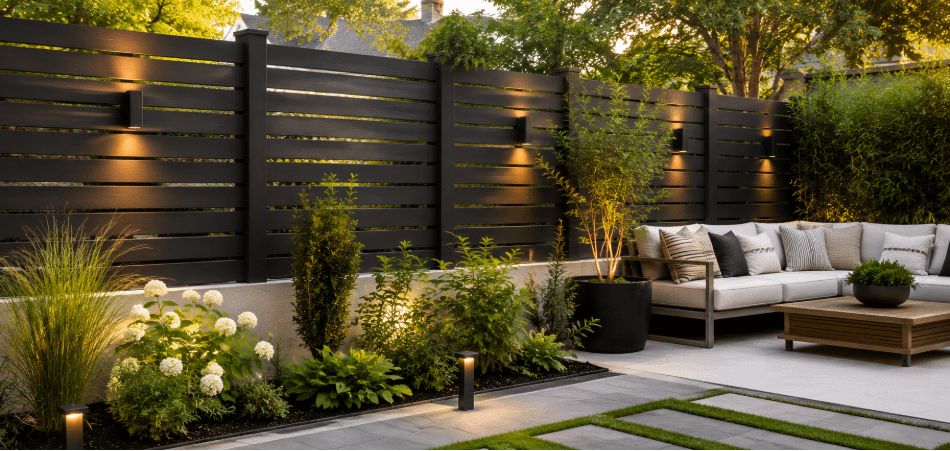
Species selection matters just as much; naturally durable, termite-resistant hardwoods hold up without chemical treatment better than softer species, though a well-maintained treated pine can still perform well on a budget. Spacing the battens correctly is what actually delivers the privacy, not the timber itself, so this is a detail worth getting right at the design stage rather than leaving to the installer on site.
read more: The Best Granny Flat Design Ideas
Living Privacy Walls: Plants, Hedges & Vertical Green Screens
Planting is the softest form of privacy, and often the most effective at reducing how enclosed a space feels while still doing the job of a solid fence. Dense hedging species suited to gardens, such as lilly pilly, murraya, or photinia, can form a full-height green wall within a couple of growing seasons with the right soil preparation and irrigation.
Vertical green screens, climbing plants trained up a wire or trellis system, work well where ground space is limited, which suits narrower courtyards and townhouse gardens common in high density developments. The trade-off is time and maintenance; a living wall needs time and care that a fixed fence doesn’t, but the result is a boundary that changes and improves the overall look and feel.
read more: The Future of Sustainable Urban Living
Decorative Laser-Cut Panels for Modern Outdoor Screening
Laser-cut panels bring a level of pattern and detail that’s difficult to achieve with standard fencing materials. Custom-cut designs, floral motifs, geometric repeats, or patterns referencing the home’s architecture, turn a screening panel into a feature rather than a backdrop.
Because the cutting is precise, these panels can be tuned for exactly how much privacy versus light transmission a space needs, denser patterns for a bathroom or ensuite courtyard, more open patterns where filtered light matters more than full screening. Powder-coated aluminium or corten steel are the most common substrates, both of which hold their finish well outdoors.
read more: Kitchen Design Ideas For Modern Homes
Pergolas, Outdoor Curtains & Blinds for Flexible Privacy Control
Not every privacy need is fixed, which is where adjustable solutions earn their place. A pergola with retractable louvres or shade sails gives control over both sun and overlooking sightlines from upper-storey neighbouring windows, without committing to a permanent structure.
Outdoor curtains and café blinds add a soft, flexible layer that can be opened for entertaining and closed for a private evening on the same deck. These work particularly well paired with a more solid, permanent screen elsewhere on the boundary, giving the space layered privacy rather than a single uniform solution.
Read more: Architecture melbourne
Key Takeaways on Designing Stylish Outdoor Privacy Spaces
Effective outdoor privacy solutions are rarely a single product; they’re a combination of materials and strategies matched to what each part of a site actually needs. Aluminium and masonry-based options suit long-term, low-maintenance boundaries, timber and breeze block bring texture and character, and planting or flexible screening handle the areas where a fixed solution isn’t the right fit.
DW Architects approaches outdoor privacy the same way we approach the rest of a home: as a design decision, not an afterthought. We pair material selection with how a space is actually used, creating outdoor areas that feel private, well considered, and built to last.
Recent Comments