
Cost to Build a House in Melbourne 2026
Anyone approaching a new build wants a straightforward answer to one question: what does it actually cost to build a house in Melbourne? The honest answer is that no single figure captures it. Costs shift with block size, site conditions, design complexity and the builder’s approach to the job.
Rather than offer a number that will be stale within a year, it helps to understand the variables that push a budget up or down.This guide explains what shapes the cost to build a house in Melbourne, from square-metre pricing conventions to the choices homeowners make along the way, so they can ask sharper questions of their builder or architect.
Read more: Architecture melbourne
How Much Does It Cost to Build a House in Melbourne in 2026?
Every homeowner starts here, and every quote will look slightly different. Two build costs rarely match, even for houses of similar size, because so much depends on site access, soil conditions, council requirements and the finish level chosen throughout. A steep block costs more to build on than a flat one, and a heritage overlay adds approval time and design constraints that flow through to price.
Builders and architects can only give a meaningful estimate once they understand these specifics. Generic averages circulating online rarely reflect what a particular block, in a particular suburb, will actually cost. Treat any broad figure as a starting point for a conversation, not a number to bank on.
read more: Interior Designers Melbourne
Average House Construction Cost Per Square Metre in Melbourne
Square-metre rates are the industry’s shorthand for comparing builds, but they hide as much as they reveal. A rate that looks competitive on paper can climb once site costs, fixtures and project management fees are added.
What the rate captures well is relative complexity. A single-storey home on a level block with a simple footprint typically sits at the lower end of any per-square-metre range.
A multi-storey home with a complicated roofline, large glazing or custom joinery pushes towards the upper end, and basements or structural steel lift the average further.
Homeowners comparing quotes should ask exactly what’s included in that headline rate. Site costs, permits and landscaping are often quoted separately, and a lower rate can simply mean more has been excluded rather than genuinely cheaper.
read more: Essential Modern Building Principles
What Factors Affect the Cost of Building a New Home in Melbourne?
Site conditions do much of the early work in setting the cost to build a house in Melbourne. Soil type determines the footing system required, and a block with reactive clay or a steep slope can add substantial cost before a single wall goes up. Access matters too. A narrow driveway or a site without easy crane access complicates delivery and adds labour hours.
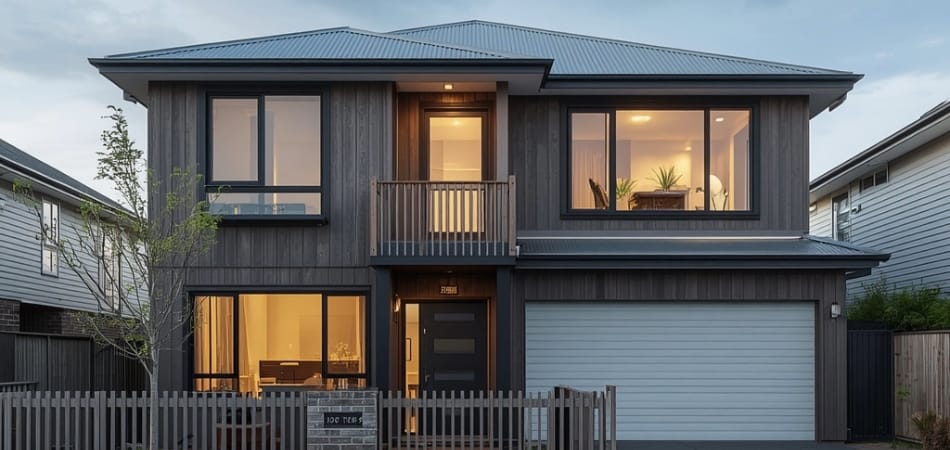
Design complexity is the next major driver. Straightforward rectangular floor plans are more efficient to build than homes with multiple wings, varied roof heights or extensive glazing. Every corner and every change in roofline adds cost in materials and time.
At DW Architects, we find that clients get the best outcomes when these site and design factors are discussed honestly at the earliest concept stage, well before council submission, rather than discovered midway through documentation.
read more: Sustainable Home Renovation Guide
How House Design Choices Influence Your Construction Budget
Floor plan efficiency has an outsized effect on the final figure. A compact, well organised layout with fewer external corners and a simpler roof structure will always build more efficiently than a sprawling one. Circulation space, such as hallways and stairwells, adds area without adding liveability, so trimming it can free up budget for the rooms that matter.
Fixtures and finishes are where budgets often blow out unnoticed. A kitchen benchtop or a bathroom tile can vary enormously in price for a similar visual outcome, and homeowners rarely see the cumulative effect of small upgrades until the final invoice arrives. Good design doesn’t mean the cheapest choice everywhere. It means spending deliberately, putting money where it will be felt daily, in natural light, storage and flow, rather than where it will simply look good in a listing photo.
read more: Architect in Beaumaris
Construction Management Options for Melbourne Home Projects
Homeowners generally choose between a head contractor managing the entire build, or a construction manager coordinating trades directly on the owner’s behalf. A head contractor arrangement offers more price certainty and less day to day involvement, while a construction management approach offers more transparency over trade costs but asks more of the homeowner’s time.
Neither model is inherently cheaper. The right choice depends on how much oversight a homeowner wants and how comfortable they are managing a live building program. Whichever path is chosen, the working relationship between designer, builder and homeowner tends to matter more than the contract structure itself.
read more: Architect in Lorne
Estimated Cost to Build 2, 3, 4 and 5 Bedroom Houses in Melbourne
Bedroom count is a rough proxy for size, but it’s a poor predictor of cost on its own. A well planned four-bedroom home can cost less to build than a poorly planned three-bedroom one, simply because floor plan efficiency and site conditions do more work than headcount.
Each additional bedroom tends to add not just floor area but often additional bathrooms, storage and structural spans, all of which compound. Larger homes also introduce more complexity in services, and a homeowner comparing a three-bedroom and a five-bedroom option should expect that gap to widen once these secondary costs are factored in.
read more: Residential Architects in Melbourne
Hidden Costs to Consider Before Starting Your Melbourne Build
Site costs are the most commonly underestimated line item. Excavation, retaining walls, stormwater connection and remediation for unexpected ground conditions can add meaningfully to a budget that looked settled at contract signing, which is why a thorough site investigation early is worth the expense.
Council fees, utility connection charges, and the cost of temporary fencing or site sheds are often left off early estimates altogether. A contingency allowance, held aside rather than spent, is the simplest protection against these surprises. Builders who quote without one are quietly transferring that risk onto the homeowner.
read more: Architect in Malvern
How to Reduce Construction Costs Without Compromising Quality
Reducing cost doesn’t have to mean reducing quality. It means being selective about where the budget goes. Simplifying the roofline, choosing a more compact footprint, and reducing the number of external corners can lower cost significantly without homeowners noticing much difference in how the finished home feels.
Staging finishes is another practical lever. Homeowners can build to a slightly plainer specification and upgrade fixtures or landscaping later, once the structure and services are locked in. The biggest savings, though, usually come from decisions made early, when the floor plan and site strategy are still open to change.
read more: Architect in Middle Park
Conclusion
There’s no single answer to the cost to build a house in Melbourne, and any figure quoted without knowing the site, the design and the finish level should be treated with some scepticism. What matters more is understanding the variables: site conditions, design complexity, construction management structure and the hidden costs that rarely make it into an early estimate.
At DW Architects we’d rather walk a homeowner through those variables honestly than offer a headline number that won’t hold up once the real site and design decisions are made. A clear-eyed understanding of what drives cost is what lets a homeowner build with confidence.
Recent Comments